
The oceans cover over 70% of our planet and play a pivotal role in regulating Earth’s climate and weather patterns. Yet, despite their immense significance, our understanding of the ocean remains limited due to its vast expanses that are difficult to observe directly. Oceanographic monitoring systems aim to address this gap by facilitating continuous surveillance of various ocean parameters. Let us explore some of the key elements and capabilities of these systems.
Types of Sensors Used
A wide array of sensors are utilized in oceanographic monitoring to gather diverse datasets. Temperature sensors measure thermal profiles across water columns. Salinity sensors provide insights into ocean salt concentrations. Current meters record flow velocities at different depths. Dissolved oxygen and pH sensors track levels of these important biogeochemical factors. Acoustic Doppler current profilers use sonar to map current directions and speeds over a wide area. Imaging sensors, cameras, and video recorders help observe marine life, seabed terrain, and other visual phenomena. Together, thoughtful combinations of these sensors allow holistic depiction of the ocean state.
Platforms for Deployment
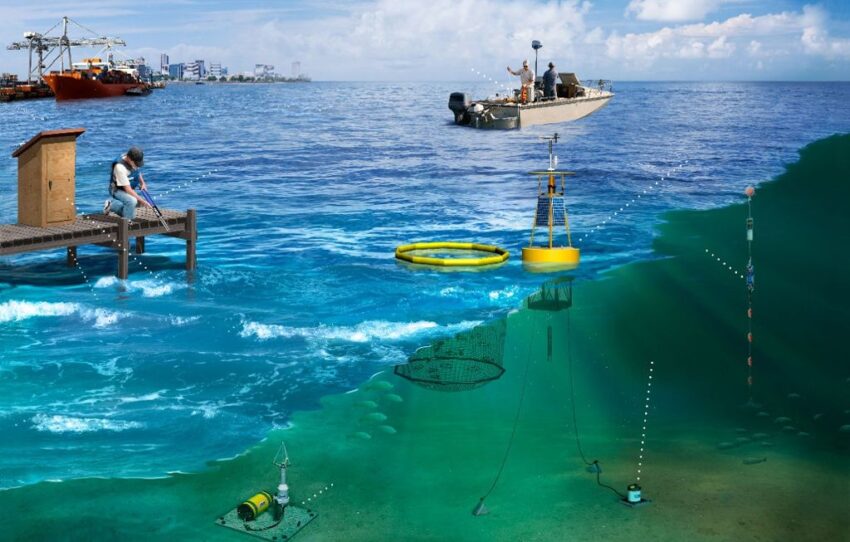
Oceanographic monitoring systems leverage various platforms and assets for sensor deployments. Moored buoys provide long-term fixed stations to monitor open ocean conditions. Coastal stations are often installed on piers, breakwaters, or seabed mounts near shorelines. Ships serve as mobile observing nodes during research cruises and voyages. Autonomous underwater vehicles like gliders and remotely operated vehicles with payloads of instruments profile the waters below the surface. Satellite sensors contribute a synoptic view from above, supplementing in-situ measurements. Floating sensor arrays, wave riders, and cabled observatories also expand coverage of the marine environment.
Real-time Data Transmission and Management
For the data gathered to be useful, oceanographic monitoring systems incorporate capabilities for real-time transmission and centralized management. Buoys, gliders, and coastal stations transmit observations via radio links to shore or low-orbit satellites. Underwater modems facilitate two-way communication with cabled and moored assets. Upon reception, data streams are processed, quality-controlled, integrated into databases, and formatted for analysis and dissemination via the internet. Tools for tracking assets, controlling payloads, and visualizing readings in maps and plots augment overall system functionality. Data preservation in long-term archives also supports future research.
Applications in Operations and Science
The insights delivered by oceanographic monitoring enrich diverse domains. Weather and storm forecasting models ingest ocean readings to enhance predictions. Fisheries management leverages understood trends in fish populations and habitats. Coastal operations utilize real-time water level, current and weather data for activities like shipping, dredging and beach safety. Ocean acidification and hypoxia research depends on sustained biogeochemical observations. Climate change studies examine ocean heat content, sea level variations and feedbacks revealed over long records. Nearshore monitoring safeguards ecosystems and public health by tracking conditions affecting tourism and recreation. Overall, continuous surveillance augments humanity’s relationship with the ocean.
Integrated Approach with Modeling
While observations provide the foundation, a truly integrated oceanographic understanding comes from combining measurements with numerical modeling. Models simulate the ocean based on governing physical, chemical and biological principles. Assimilating real-time and historical monitoring data helps constrain and improve model accuracy. In turn, models offer dynamic insights into broader regions between observing points. Data-model fusion allows extrapolating localized observations, attributing causes to shifts, and making probabilistic future projections. Emerging capabilities like data assimilation, ensemble modeling and artificial intelligence are enhancing such integration for comprehensive ocean knowledge.
Key Challenges
Despite advances, ocean observing still faces obstacles. Maintaining systems demands resources, necessitating international coordination and public-private partnerships. Harsh marine conditions accelerate asset wear, requiring robust engineering. Spatial and temporal gaps persist due to high costs of full coverage. Biological and biogeochemical observations remain limited compared to physical domains. Standardizing measurement protocols and data formats presents ongoing challenges. Moreover, transforming gigantic volumes of data into usable information for stakeholders needs dedicated expertise and infrastructure. Nonetheless, overcoming such obstacles will elevate scientific understanding and realize practical benefits from our global ocean.
As climate change alters ocean dynamics, continuous oceanographic monitoring grows ever more imperative. Comprehensive observing networks, smartly integrating diverse platforms, sensors and modeling, can deliver the prolonged, widespread surveillance needed. With coordinated global support, such systems hold promise to revolutionize how we perceive, safeguard and sustainably harness the critical resource that is our ocean – the lifeblood of our blue planet.
*Note:
1.Source: Coherent Market Insights, Public sources, Desk research
2.We have leveraged AI tools to mine information and compile it