
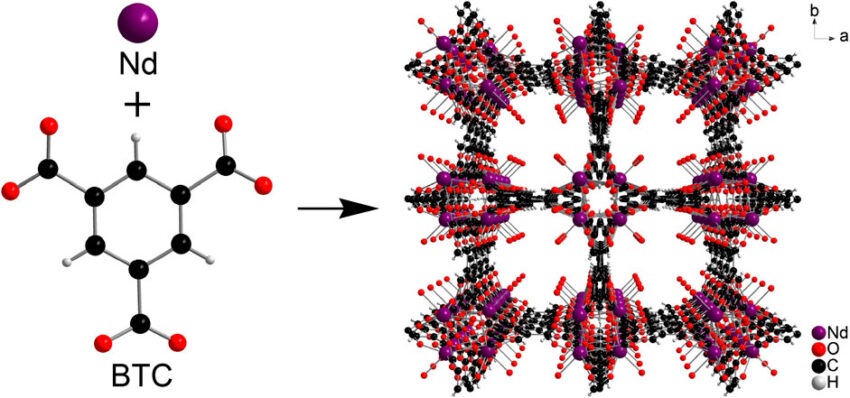
Metal-organic frameworks, commonly known as MOFs, are a new class of highly porous crystalline materials composed of metal ions or metal-containing clusters connected by organic ligands. These frameworks can form structures with nanometer-scale cavities and ultra-high surface areas. Since their discovery in the late 1990s, MOFs have attracted significant research interest due to their potential applications in gas storage, separation, sensing, drug delivery, and catalysis.
Crystalline Structure and Metal Organic Frameworks
Metal Organic Framework possess well-defined crystalline structures with metal-ligand coordination bonds that give them stability and porosity. The metal ions or clusters act as nodes that are linked together by organic ligands into one-, two-, or three-dimensional configurations. This results in evenly distributed nanoscale pores and channels throughout the entire framework. The metal-ligand bonds allow for a nearly infinite variety of structures by combining different metals and organic linkers. For example, over 20,000 MOF structures have been reported based on just a few common metals and ligands.
Tunable Porosity and Surface Area
One of the most remarkable properties of MOFs is their exceptionally high internal surface areas, often exceeding 5,000 m2/g. This compares to hundreds of m2/g for typical zeolites. Their porosity can also be systematically tuned by altering the metal-ligand combinations or applying topological changes to the underlying structure. As a result, MOF pore sizes ranging from micropores (less than 2 nm) to macro pores (over 50 nm) can be synthesized. This wide-ranging tunability of surface area and pore characteristics makes MOFs promising for numerous gas and fluid storage, separation, and catalysis applications.
Gas Storage Applications
MOFs have shown great potential as next-generation porous materials for industrial gas storage. Their high surface areas allow dramatically increased gas uptake compared to traditional adsorbents like activated carbon and zeolites. Several MOFs have exceeded Department of Energy targets for high-capacity storage of natural gas, methane, hydrogen, and other fuels. For instance, MOF-177 can adsorb up to 5.5 wt% hydrogen at 77 K and 100 bar, surpassing the DOE’s 2017 goal. Ongoing research is further optimizing MOF structures and binding interactions for industrial-scale gas storage in vehicles and infrastructure.
Gas Separation Applications
The ordered nanoporosity and tunable pore sizes/shapes of MOFs also make them promising adsorbents for gas separations. MOFs have been investigated for capturing carbon dioxide from flue gases, separating air into its constituent gases, and purifying natural gas. Experimental and theoretical studies have demonstrated high selectivities for separations including CO2/CH4, O2/N2, propylene/propane, and others. At the industrial scale, MOF membrane technology could enable energy-efficient separations for emissions control and petrochemical processing. Continued work aims to design MOFs with optimized pore structures and chemical selectivities for real-world gas separation applications.
Potential in Sensing and Catalysis
MOFs also show applications as chemical sensors and heterogeneous catalysts. The accessibility of metal sites and functionalizable pore surfaces allow MOFs to detect target molecules through changes in optical, electrical, or acoustic properties. This has led to MOF-based sensors for toxins, explosives, and food/environmental contaminants with sensitivities down to parts-per-million or lower. Meanwhile, MOFs often exhibit high specific surface areas and tunable metal centers for catalysis. This has resulted in MOF catalysts reported for reactions such as carbon dioxide reduction, water splitting, fuel cells, and petrochemical conversions. Integration of sensing and catalytic functions could realize “smart” multifunctional MOF materials in the future.
Drug Delivery and Biomedical Uses
Recently, research into biomedical applications of MOFs has emerged. Their highly tunable properties, biocompatibility, and drug loading capacities make MOFs promising carriers for targeted drug and gene delivery. MOF nano/microparticles can be functionalized with targeting ligands and encapsulate both small and large molecule drugs. Their porous structures enable controlled release profiles through degradation or external stimuli. A few MOF formulations have already advanced to in vivo studies for cancer therapy, inflammation treatment, and vaccine development. Prospects also include uses as bioimaging probes, tissue engineering scaffolds, and antimicrobial coatings. Continued progress in this area may lead to new MOF-based therapies and medical technologies.
Over the past two decades, MOF research has demonstrated the enormous potential of these materials for gas handling, separation, sensing, catalysis, and biomedical uses. However, challenges remain in further optimizing MOF properties, stability, scale-up synthesis, and integration into commercial systems and devices.
In developing structure-property relationships through computational modeling and high-throughput methods may accelerate future MOF design. Industrial collaboration will also aid the commercial realization and manufacturing of MOF technologies. As a relatively new class of porous materials, MOFs have already shown the ability to outperform existing adsorbents and molecular frameworks in many applications. With continued advancement, MOFs are well poised to revolutionize numerous industries through their chemically tunable porosity at the nanoscale.