
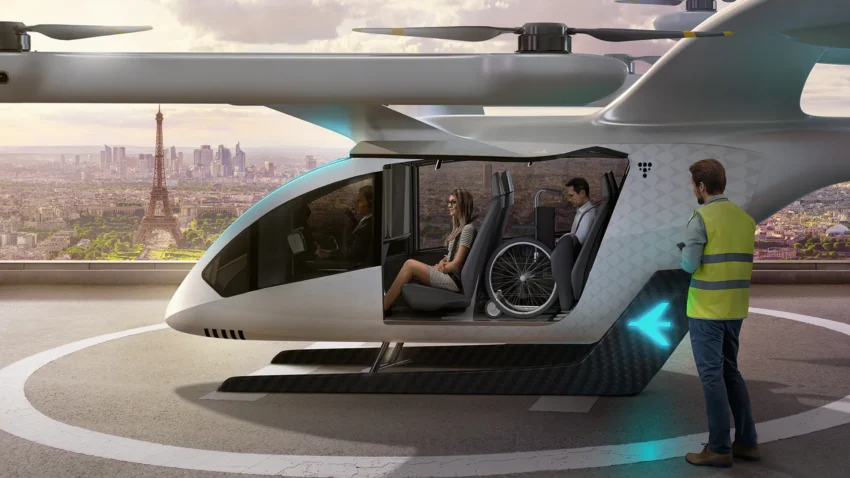
NASA’s Langley Research Center in Virginia has successfully flown multiple drones autonomously without the need for a pilot or visual observer. The drones were able to navigate around obstacles and each other during takeoff, along a predetermined route, and upon landing. This remarkable achievement is a significant step towards advancing self-flying capabilities for air taxis.
The test involved flying the drones beyond visual line of sight, meaning that neither the vehicle nor the airspace was monitored directly by human observation. This required extensive research into automation and safety systems, as well as special approval from the Federal Aviation Administration and NASA. The ability to autonomously navigate in complex environments without visual assistance is crucial for the future integration of air taxis into urban airspace.
One of the key benefits of using drones for this research is the safety and cost-effectiveness of testing self-flying technology on a smaller scale. By observing how the drones avoid obstacles and each other, researchers can gather valuable insights that can be applied to larger, passenger-carrying air taxis.
NASA is also testing elements of automation technology using helicopters as stand-in aircraft. This allows NASA to develop and refine the autonomy required for self-flying air taxis before they are fully integrated into the skies.
Lou Glaab, the branch head for the aeronautics systems engineering branch at NASA Langley, explained the importance of testing automation technologies in a busy area with high volume air traffic. As the vision for Advanced Air Mobility (AAM) involves multiple vehicles operating from vertiports located adjacent to airports or within communities, it is critical to ensure that these automation technologies can safely handle the demands of a busy airspace.
The recent flights used purchased ALTA 8 Uncrewed Aircraft Systems, commonly known as drones, equipped with software that enables airspace communications, flight path management, and avoidance of other vehicles. These skills are essential for operating in a busy airspace where drones and air taxis will coexist in the future.
The flights were observed from NASA Langley’s Remote Operations for Autonomous Missions control center, while the drones took off and landed at the City Environment for Testing Autonomous Integrated Navigation test range. This allowed researchers to closely monitor the performance of the autonomous flights in a controlled environment that closely resembles real-world conditions.
NASA plans to transfer the technology developed during this project to the public, ensuring that industry manufacturers have access to the software while designing their own vehicles. This technology transfer will greatly benefit the industry, as it will allow manufacturers to leverage NASA’s expertise and advancements in autonomous flight.
Two notable technologies used in the flights were ICAROURS and Safe2Ditch. ICAROURS, or NASA’s Integrated Configurable Architecture for Reliable Operations of Unmanned Systems, provides an autonomous detect-and-avoid function, ensuring that the drones maintain a safe distance from other air traffic. Safe2Ditch, on the other hand, allows the vehicle to autonomously identify the safest place to land in the event of an in-flight emergency by observing the ground below.
The project, known as the High Density Vertiplex, is part of NASA’s Advanced Air Mobility (AAM) mission. It focuses on testing and evaluating the infrastructure required for the frequent takeoff and landing of air taxis, as well as the technological advancements necessary to make this vision a reality. The success of these autonomous flights brings us one step closer to a future where air taxis operate seamlessly in urban environments.
*Note:
1. Source: Coherent Market Insights, Public sources, Desk research
2. We have leveraged AI tools to mine information and compile it